








Where Guangzhou Sits on the Map
In southern China, where the Pearl River fans out into its broad delta, lies Guangzhou, capital of Guangdong province — the city the world knew for centuries as "Canton" before its current name took hold. The river's banks thread through both the old and modern quarters of the city, which sits roughly 120 kilometers northwest of Hong Kong, making it an easy stop for travelers heading into southern China from the Gulf or East Asia.
Engine of Chinese Industry and Trade
No account of China's economy is complete without Guangzhou, firmly established as one of the country's three major economic cities alongside Beijing and Shanghai. Its commercial weight shows twice a year when the doors of the Canton Fair open — founded in 1957 and still the largest trade fair in China, drawing buyers and suppliers from every continent. Beyond the fair, the city is dense with sprawling wholesale markets for clothing, electronics, leather goods, and gifts, a daily destination for Arab import-export traders seeking bulk goods straight from the factory. Meanwhile, glass office towers rise in Zhujiang New Town, the city's modern financial core, anchored by the well-known Huacheng Square.
Population and Climate
According to the 2020 census, Guangzhou is home to about 18.7 million people, making it one of China's most densely populated cities. Its climate is humid subtropical, with a long, hot, humid summer and a comparatively short, mild winter next to China's northern cities — meaning it can be visited year-round, though autumn and spring suit travelers who prefer calmer weather.
When Arab Traders First Reached the Pearl River's Banks
Guangzhou's ties to the Arab world trace back to the Tang dynasty, when its port was a major stop on the maritime Silk Road, drawing Arab and Persian merchants who settled, married, and built new lives in the city. Among the clearest traces of that history is the Huaisheng Mosque, which traditional Chinese Islamic accounts credit to the companion Sa'd ibn Abi Waqqas, said to have laid its foundation in the 7th century, alongside the Abu Waqqas and Xiaodongying mosques that still serve the Muslim community today.
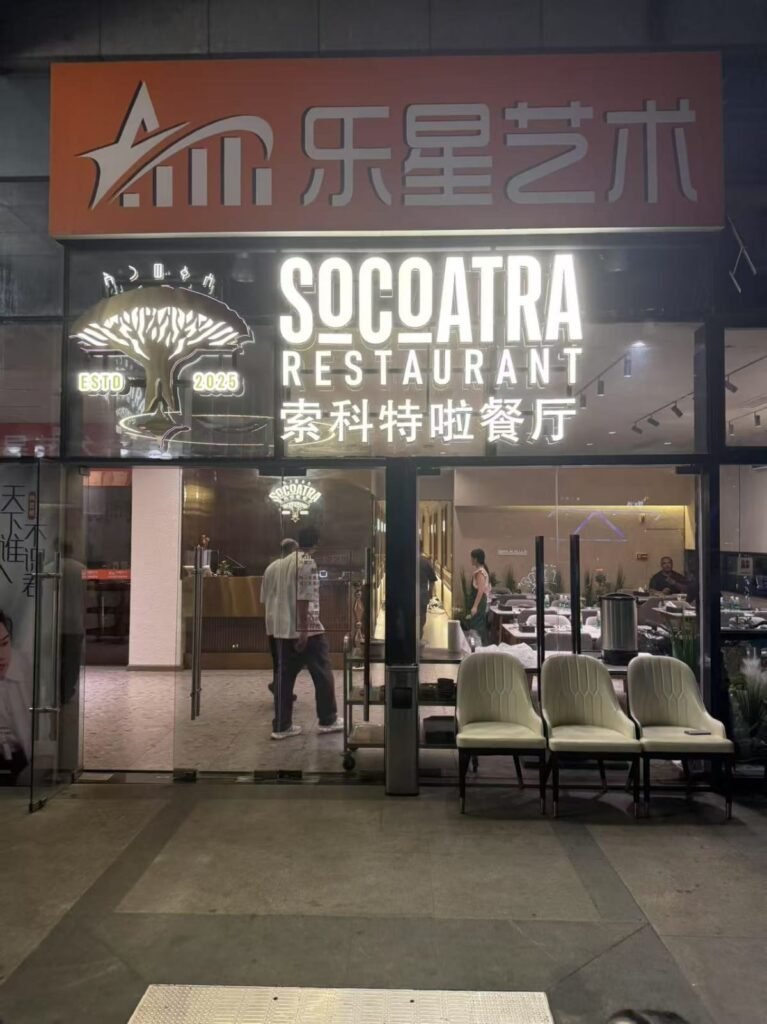
In the well-known Xiaobei district, Arabs and Muslims still form one of the largest such communities in China, with dozens of Arab and halal restaurants — Yemeni, Lebanese, Syrian, Turkish, Iraqi, Moroccan, even halal Mexican — giving Arab visitors a taste of home thousands of kilometers away.
What's Worth Seeing in Guangzhou
- Canton Tower: one of the tallest towers in the world at over 600 meters, offering sweeping views of the city and both riverbanks.
- Chen Clan Academy: a traditional Chinese architectural masterpiece with intricate wood and stone carvings.
- Shamian Island: a quiet retreat in the heart of the city, lined with European colonial-style buildings, cafés, and tree-shaded lanes.
- The Opera House, designed by the late architect Zaha Hadid, alongside the neighboring Guangdong Museum, the Gothic stone Sacred Heart Cathedral, and the Western Han Nanyue King Museum.
- A night cruise on the Pearl River, revealing the city's illuminated skyline after dark.
With all this heritage layered atop an active commercial present, Guangzhou remains the leading gateway Arab businessmen cross to enter the Chinese market — bridging a history stretching back more than a thousand years with a fast-moving economic present that never slows down.