

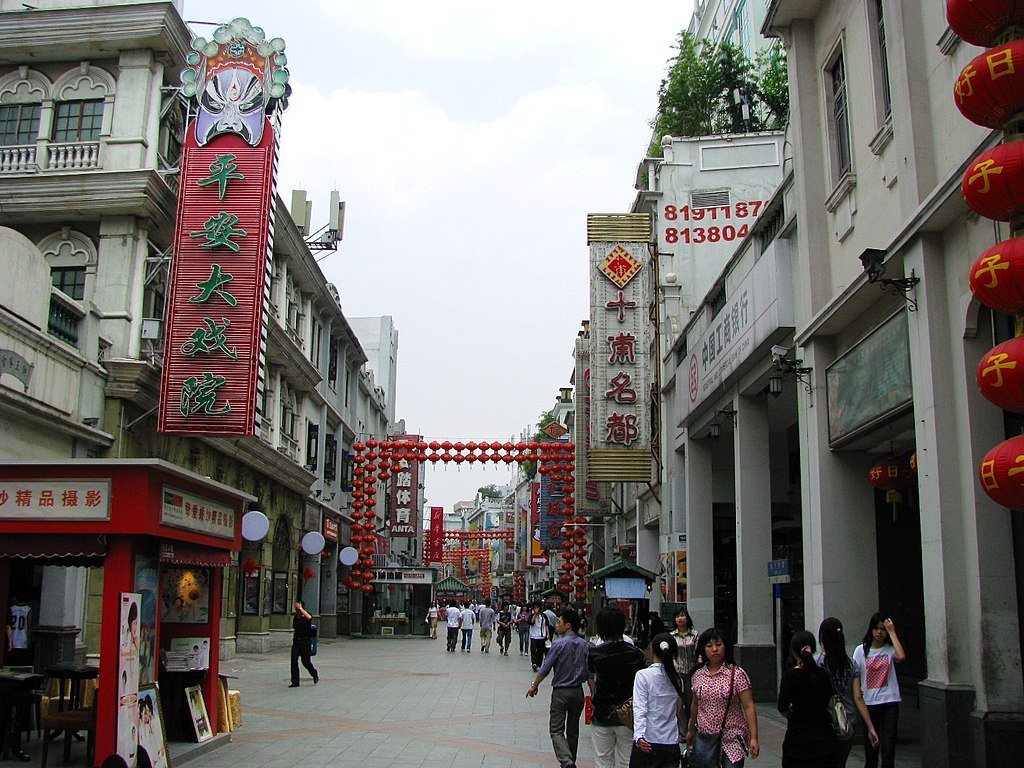
Beijing Road is Guangzhou's most famous pedestrian shopping street, located in the heart of Yuexiu District in the city centre and stretching for about 1.5 kilometres lined with shops, restaurants and historical sites. The site's history goes back more than 2,000 years, it was once known as Baiyun Road during the Ming and Qing dynasties, and served for centuries as a major commercial artery for Guangzhou, one of southern China's most important trading ports. In 1995 the street was officially converted into a fully pedestrianised zone, and it has since undergone continuous renovation and expansion that reorganised its storefronts while preserving its distinctive historical character.
One of Beijing Road's most striking features is the glass panels set into the street's own pavement, revealing to visitors layers of ancient roadways uncovered during renovation work in the early 2000s, dating back to the Song, Yuan, Ming and Qing dynasties, with some of the discovered relics reaching as far back as the Tang dynasty. This rare mix of contemporary shopping and visible historical remains underfoot makes Beijing Road a very different experience from an ordinary mall, letting visitors experience old and modern Guangzhou at the same time.
Commercially, the street is lined with hundreds of shops selling clothing, shoes, accessories and local souvenirs, alongside small electronics stores and multi-storey shopping arcades, with prices to suit every budget. Restaurants and cafes serving local Chinese food and popular street snacks are everywhere, especially in the evening, when the street turns into a lively, brightly lit thoroughfare. It's easily reached via Gongyuanqian metro station on Lines 1 and 2, directly through Exit E, just a short walk from the start of the street.
What matters most for Gulf traders and shoppers is that Beijing Road sits very close to Yide Road, one of Guangzhou's oldest and most important wholesale corridors, known specifically for toys, festive decorations, artificial flowers, packaging supplies and stationery sold in bulk, as well as the Baima wholesale clothing market, which traditionally receives large numbers of buyers from the Middle East, Africa and Eastern Europe. The two areas are connected by Haizhu Square station, one of the city's most important metro interchange points. Many Gulf traders therefore combine a personal-shopping and sightseeing visit to Beijing Road with a business trip to the nearby Yide Road markets, keeping in mind that bargaining is expected and accepted at the surrounding wholesale shops, unlike Beijing Road's main retail stores, where prices are mostly fixed.
Beijing Road really comes alive in the evening, when shop and restaurant fronts light up and the pavements fill with street vendors and food carts, giving visitors an experience close to a traditional Chinese night market. Comfortable walking shoes are recommended given the distances involved, especially since the entire street is closed to cars, and the autumn and spring months (September to November and March to May) are the best times to visit, avoiding Guangzhou's intense summer heat and humidity.
Visitors can also combine Beijing Road with the famous Shangxiajiu Street in Liwan District in a single itinerary to compare the historic shopping experiences on the city's east and west sides, the two streets share a similar heritage character blended with modern retail, but differ in the type of shops and specialised markets found nearby.

Beijing Street
⭐ —
(0 ratings)
·
Rate this place:
Beijing Road is Guangzhou's most famous historic pedestrian street, combining 2,000-year-old relics under glass with modern shops, and lying close to the Yide Road wholesale markets.
Similar Places

China Plaza
📍 No. 33, Zhongshan 3rd Road, Yuexiu District, Guangzhou

Tee Mall
📍 No. 208, Tianhe Road, Tianhe District, Guangzhou

Uniqlo
📍 F2 Floor, Victoria Plaza, VT101, No. 101 Tiyu West Road, Tianhe District, Guangzhou
Shanshubajiu Street
📍 120 meters northeast of the intersection of Shangxiajiu Pedestrian Street and Shibapu North Road, Liwan District, Guangzhou
💬 Comments
No comments yet — be the first to share your experience!