Before Muscat became a modern capital, it was a fortified harbor fought over by colonial and naval powers for centuries. Old Muscat, the small district ringed by mountains at the harbor's mouth, keeps that history visibly alive today.
Al-Jalali and Al-Mirani forts: a Portuguese imprint
Both forts were built in the 1580s by the Portuguese, who then occupied Muscat, after the harbor suffered two consecutive Ottoman raids that convinced them it needed heavy fortification. Al-Jalali Fort, on the eastern side of the harbor mouth, later became Oman's main prison for much of its history before being closed and converted into a private museum, usually opened to the public only on limited occasions. Al-Mirani Fort, on the western side, remains a restricted military site to this day, but its silhouette from the corniche or from the sea remains one of Muscat's most iconic sights.
Expelling the Portuguese and Yaruba rule
In 1650, the Omani Imam Nasir bin Murshid Al-Ya'rubi expelled the Portuguese from Muscat after a long siege, ending a presence that had lasted more than a century and a half on the Omani coast. This victory is considered a founding moment for independent Omani maritime identity, later laying the groundwork for an Omani naval empire whose influence extended to Zanzibar and East Africa.
Al Alam Palace and Muscat Gate
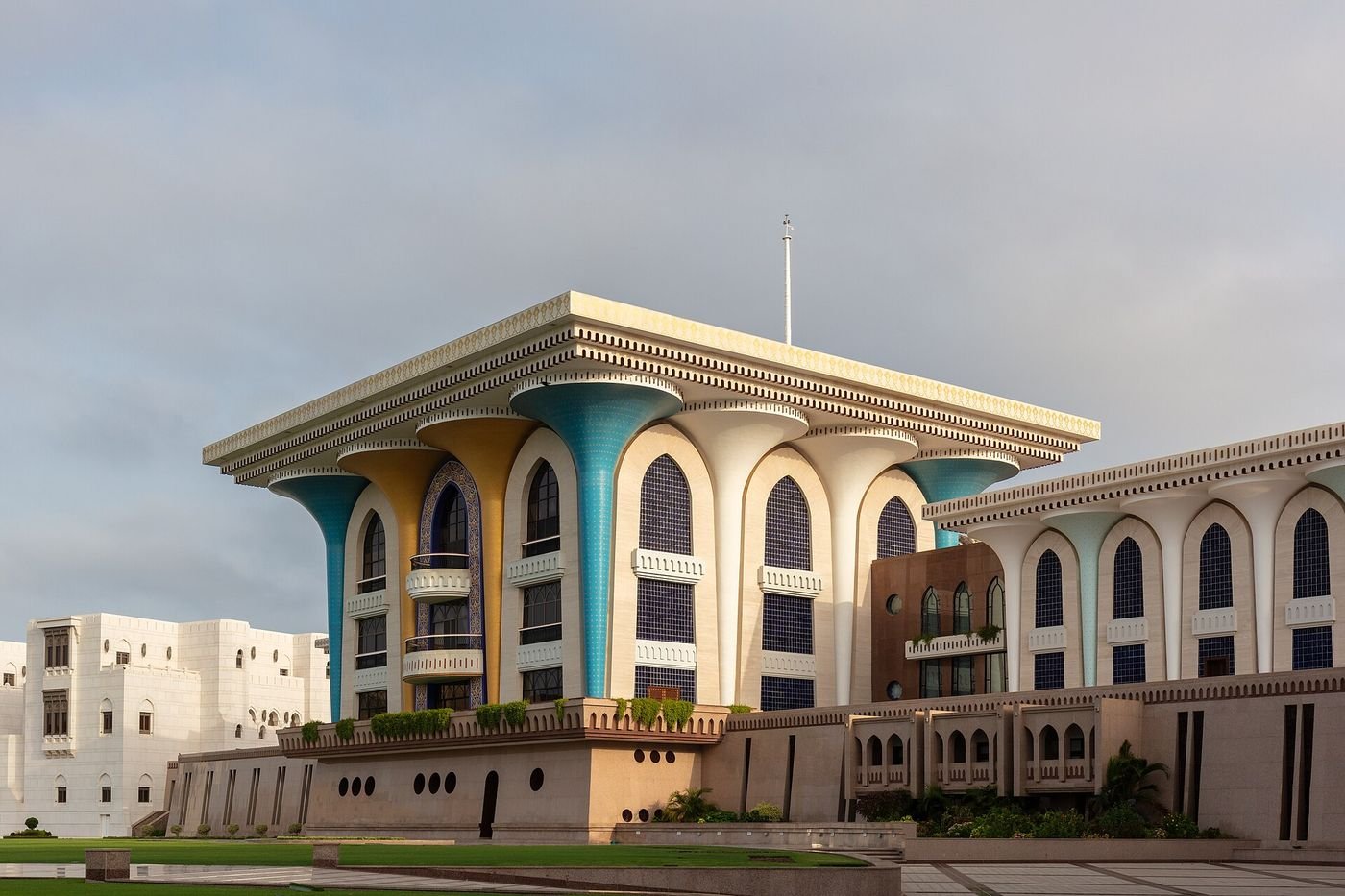
Al Alam Palace, the Sultan's ceremonial reception palace (not his permanent residence), sits at the heart of Old Muscat with its distinctive gold-and-blue-columned façade, built in the 1970s in a modern Omani style. The historic Muscat Gate, the old walled city's traditional entrance, still stands as a reference point for wandering on foot between the sites.
Bait Al Zubair Museum
For a deeper understanding of traditional Omani life before oil, the privately-run Bait Al Zubair Museum presents an authentic collection of traditional weapons, silver jewelry, costumes, and everyday household items gathered by one prominent Omani family over decades — more intimate and detailed than the larger state museums.
Visiting tip: the best time to photograph the two forts is at sunset from the adjacent Muttrah Corniche, where the evening light reflects off the water in front of the old stone fortifications, while actually walking through Old Muscat itself is more pleasant in the morning before midday heat sets in.