

Guangzhou Library, often referred to locally as the Guangdong Library, is one of the largest public libraries in China and one of the most architecturally striking landmarks in the Zhujiang New Town district. The library itself was founded in 1982, but its current landmark building was not officially opened to the public until 23 June 2013, after the old building was closed in April of the same year so its entire collection could be relocated to the new site on the banks of the Pearl River. Today the library stands as one of the anchors of Huacheng Square, alongside the Guangzhou Opera House and the Guangdong Museum, at the heart of the city's new central axis that has, over the past two decades, become Guangzhou's modern face to the world.
## Architectural design
The building was designed by the Japanese firm Nikken Sekkei, winner of the international architecture competition held to select the new library's design, under a concept the designers called "Beautiful Books". The structure consists of a north tower and a south tower; viewed from east to west, their alignment forms a shape resembling the Chinese character "之", a symbol associated with continuity and flow. The cascading, overlapping layers on the building's facade visually echo stacks of open books, while also expressing the idea of history and culture intertwining over time, with elements of traditional Lingnan architecture woven into the facades and interior arcades.
## What visitors can see
The library covers a total area of roughly 100,000 square metres and offers around 4,000 reading seats and 500 public computers free of charge, alongside thousands of wired internet connections. Its holdings exceed 8.43 million items, including more than 3.2 million traditional books and around 6,793 rare books and manuscripts, making it one of the most important cultural references in southern China. Visitors can wander through floors dedicated to different age groups, from children's sections equipped with interactive play-and-read spaces to quiet study floors and reading rooms devoted to research and rare references. Even for those who cannot read Chinese, the visit is worthwhile simply for walking through the spacious, naturally lit interior corridors behind massive glass facades overlooking Huacheng Square and the Pearl River — one of the most popular spots for photographers in Guangzhou, especially at sunset when the lights of the neighbouring Opera House reflect off the library's glass exterior.
## Practical visiting tips
Admission to the library is completely free for all visitors, and no advance booking is required to explore the public floors. The library is closed every Wednesday, but operates as usual on public holidays. Opening hours vary by floor: floors one to seven of the North Building are open from 9:00 am to 9:00 pm, while the eighth and ninth floors, along with the South Building, operate from 10:00 am to 5:30 pm. Visitors are advised to keep quiet inside the reading halls out of respect for local patrons, and to avoid eating or drinking in the main halls. The easiest way to get there is by metro via Grand Theatre (Guangzhou Opera House) station on the APM Line, where Exit B leads directly to Huacheng Square just steps from the library entrance. The official address is No. 4 Zhujiang East Road, Tianhe District.
## Nearby places worth visiting
Thanks to its strategic location in the heart of Huacheng Square, Guangzhou Library is surrounded by some of the city's most notable landmarks, all within walking distance: the Guangzhou Opera House, designed by the late architect Zaha Hadid, just minutes away; the Guangdong Museum with its extensive archaeological and art collections; and the Guangzhou Children's Palace. Visitors can continue the tour toward the nearby Poly World Trade Center, or head to the Canton Tower overlooking the Pearl River, a short metro ride or walk away via the modern pedestrian bridges connecting the districts of Zhujiang New Town. This whole area ranks among the best spots in Guangzhou for spending half a day combining knowledge, art and modern architecture — starting with a quiet morning tour of the library, moving to the neighbouring museum at midday, and ending the evening watching the Opera House and surrounding skyscrapers lit up around Huacheng Square, a night scene that draws Guangzhou locals themselves as much as visitors.
For those planning a longer visit, several cafes and small restaurants are available right around the library inside underground retail complexes that link the metro stations to the main buildings on the square, making it comfortable to move between landmarks even during hot summer days or rain. Photography enthusiasts are advised to visit the library's front facade in the early morning to avoid crowds and take advantage of the natural side lighting that highlights the details of the tiered glass facade.
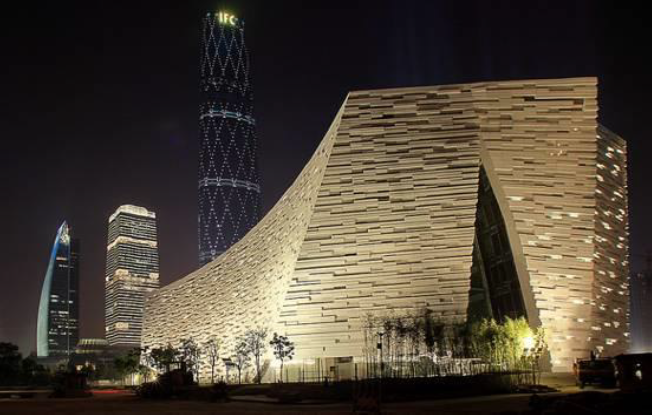
Guangdong Library
⭐ —
(0 ratings)
·
Rate this place:
Guangzhou Library, famous for its book-shaped design in the heart of Huacheng Square, blends modern Japanese architecture with one of southern China's largest book collections — and admission is free.
Similar Places

Zhujiang New Town
📍 Huacheng Avenue, Tianhe District, Guangzhou (320 meters walk from Exit C of Liede Subway Station)

Huaisheng Mosque
📍 56 Guangta Road, Yuexiu District, Guangzhou

Huacheng Square (Flower City Square)
📍 Huacheng Square, Tianhe District, Guangzhou (200 meters walk from Exit A of Huangpu Avenue Subway Station)

Abu Waqqas Mosque
📍 210-11 West Huanshi Road, Yuexiu District, Guangzhou
💬 Comments
No comments yet — be the first to share your experience!