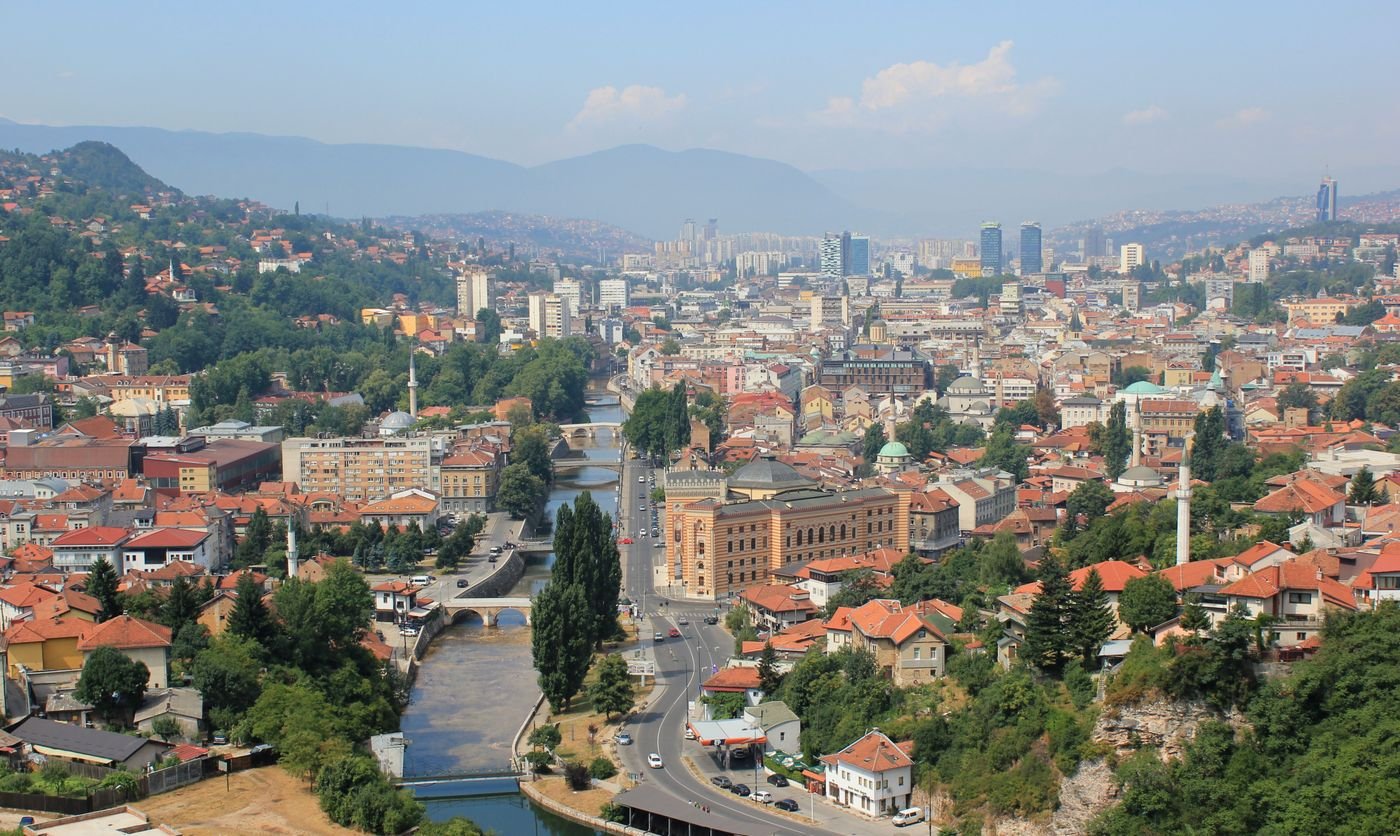
Baščaršija is widely called "the heart of Sarajevo," the historic quarter founded by the Ottomans in the 15th century as the city's main marketplace. The name itself literally translates to "main market," an apt description for a neighborhood of narrow cobblestone lanes lined with small shops selling copperware, silver, Bosnian coffee sets, and handicrafts largely unchanged in spirit for centuries.
The natural starting point for any walk is Sebilj Square, home to the wooden Ottoman-style fountain rebuilt in 1891 in the Istanbul tradition, after fire destroyed the original 1753 structure. Local legend holds that anyone who drinks from its water is destined to return to Sarajevo — a ritual thousands of visitors still perform each year. Flocks of pigeons gather around the square, making it one of the most photographed spots in the city.
A short walk from Sebilj stands the Gazi Husrev-beg Mosque, built in 1531 by the Ottoman governor whose name it bears. It is the largest mosque in Bosnia and Herzegovina and one of the finest examples of classical Ottoman architecture anywhere in the Balkans. Its minaret rises 47 meters, and remarkably, it became the first mosque in the world to be electrified, in 1898 — a fact Sarajevans take great pride in. Non-Muslim visitors can enter outside prayer times for a small fee, provided they dress modestly and remove their shoes.
Right beside the mosque sits Morića Han, one of the rare surviving Ottoman-era caravanserais from the days of trading caravans, now converted into a traditional café and restaurant — a perfect stop to try Bosnian coffee brewed the old way in a copper džezva pot.
No visit to Baščaršija is complete without wandering Kazandžiluk, the famous coppersmiths' alley where artisans still hand-hammer coffee pots and trays exactly as their ancestors did five centuries ago. This is the best place in the city to buy authentic souvenirs rather than imported tourist trinkets.
Practically speaking, Baščaršija can be fully explored on foot in a single day, though at least half a day is recommended to wander unhurried, stop at cafés, and sample local food such as ćevapi (grilled minced-meat sausages in flatbread) and burek (meat- or cheese-filled pastry). The best time to visit is early morning, before 9am, to avoid crowds and get clean photos of the landmarks, or in the evening after sunset, when warm lighting on the minaret and historic buildings creates a magical atmosphere.
Nearby stands the Latin Bridge, the historic bridge where the assassination of Archduke Franz Ferdinand in 1914 sparked World War I, and the Moorish-style City Hall (Vijećnica), one of Sarajevo's most beautiful buildings, badly damaged during the siege and fully restored since.
For Gulf and Saudi travelers, Baščaršija feels comparatively familiar thanks to the quarter's Islamic Ottoman character: working mosques for prayer, naturally halal traditional Bosnian food (no special labels needed, as the classic cuisine here is halal by default), and a safe, family-friendly atmosphere that's pleasant to explore even after dark.