

Understanding Barcelona's historical layers makes visiting it a far richer experience than just snapping photos in front of landmarks. The city we see today was built over more than two thousand years of change.
Roman Roots: Barcino
Before it was a Roman settlement, the area was home to Iberian residents who called it "Barkeno." The Romans transformed it into a colony named "Barcino" in the 1st century BC, granting it city status, building a public forum, walls, an aqueduct, and a temple to Emperor Augustus. Retired Roman soldiers settled there, but it quickly grew into an important trading hub thanks to its position on the water.
The Middle Ages: Prosperity and Expansion
After the fall of the Roman Empire, Barcelona gradually flourished until it became one of the most important economic and political centers of the western Mediterranean. During this prosperous era, spanning the 13th to 15th centuries, the Gothic Quarter (Barri Gòtic) took shape roughly as we know it today, with its narrow alleys and closely-packed stone buildings.
Surprise: The Gothic Quarter Isn't Fully Gothic
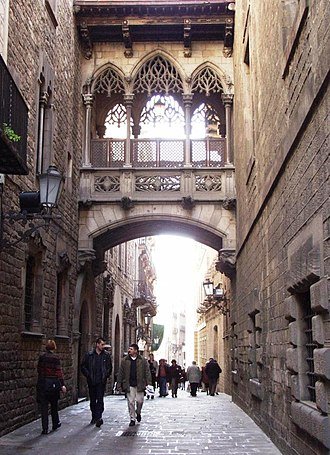
Ironically, much of what looks "Gothic" in the quarter today was actually added later. As Barcelona prepared for the 1929 Universal Exhibition, the city felt its historic quarter wasn't "Gothic enough," and funded an extensive redesign: the city's cathedral was given a new Gothic-style façade, the famous Carrer Bisbe bridge was built, and Antoni Gaudí was commissioned to design the street lighting in the adjacent Plaça Reial — lamp posts of his design that still stand there today.
From Industrial City to Modernist Capital
By the late 19th century, Barcelona underwent a massive urban expansion known as the "Eixample" plan, which reorganized the city with wide, straight streets and laid the groundwork for a wave of Catalan modernist architecture (Modernisme), led by architects including Antoni Gaudí, who transformed the city into an open-air museum of buildings with curved lines and colorful mosaics.
Why This Matters as You Wander
When you walk today between the Gothic Quarter and Passeig de Gràcia, you're effectively crossing between two adjacent time layers: the medieval period with its gray stone, and the early 20th century with its bold colors and shapes. This juxtaposition is what gives Barcelona its unique character among European cities.
💬 Comments
No comments yet — be the first to share your experience!